
1st Cavalry Division (Airmobile) or the First Team
The 1st Cavalry Division consisted of three infantry brigades - 1st, 2nd and 3rd, plus a large number of support units. Of the three brigades, one was airborne and that was our unit, the 1st Brigade (Airborne). The 1st Brigade had three battalions, each with approximately 900 troopers - the 1st Battalion, 12th Cavalry Regiment; 1st Battalion, 8th Cavalry Regiment; and our unit, 2nd Battalion, 8th Cavalry Regiment. The 2nd Battalion 8th Cavalry Regiment was commanded by a lieutenant colonel and had a Headquarters Company and four infantry companies - A, B, C, D (or Alpha, Bravo, Charlie, Delta), commanded by captains.
|
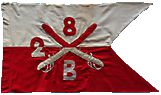
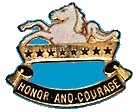
8TH CAVALRY REGIMENT UNIT INSIGNIA |
|||
|
|
|
||
A demi-horse issuant rampant Argent from a band fessways Or charged with eight mullets Azure pierced of the second, surmounting a ribbon scroll Sable with the regimental motto "HONOR AND COURAGE" of the second. Symbolism: The eight mullets show the regimental number and Cavalry tradition ascribing the origin of the pierced mullet to the rowel of a spur. This is further indicated by the horse. |
|||
Bravo Company consisted of three rifle platoons and a weapons platoon. The total strength of the company was around 160 troopers, including 6 officers - company commander, executive officer and 4 platoon leaders. Although our assigned strength was around 160 troopers, our typical field strength was around 110-120 because we always had many troopers who were either joining our unit, rotating home, or on Rest & Recuperation (R&R) leave. In the field the company command group consisted of the company commander, 1st Sergeant, supply coordinator, and two radio operators (one for the battalion net and one for the company net), a company medic or “Doc”, and an artillery liaison team. The Artillery Liaison Team consisted of an artillery lieutenant forward observer (FO) and a radio operator, and they were our experts for coordinating artillery and tactical air support. The executive officer had a small detachment that took care of all the administrative and supply actions for our company and they were collocated with the Battalion Headquarters at a firebase. When it was fully manned, a rifle platoon had approximately 40 troopers and the weapons platoon had about 25 troopers. Each rifle platoon had a Platoon Leader (usually a lieutenant), a Platoon Sergeant, 3 infantry squads and a machine gun squad. An infantry squad had two fire teams, and the squad leader was a staff sergeant and the leader of each fire team was a sergeant.
The vast majority of Bravo Company troopers had been drafted into the army. According to our company roster from April 1968, Bravo Company had 1 captain, 4 lieutenants, 4 E-7 platoon sergeants, 7 E-6 squad leaders, and 137 troopers with the rank of E-5 or below. Out of this last figure of 137 troopers, 78% were draftees and the remainder enlistees. Another special feature of infantry company-sized units in Vietnam was that they were responsible for selecting and promoting their own junior Non-Commissioned Officers (NCOs) from assigned personnel. The normal practice was that only a handful of professional NCOs were assigned to an infantry company, typically the 1st Sergeant, platoon sergeants and we only had seven with the rank of squad leaders (E-6). Of the 33 E-5 sergeants who served as squad leaders and team leaders, all were promoted from the ranks during their service in Bravo Company and this was based on demonstrated leadership ability, and totally ignoring the peacetime criterion of time-in-grade. This dictated a rapid promotion system and these NCOs were usually promoted during the last 6 months of their tour in Vietnam. This reliance on promoting NCOs from assigned personnel was certainly not without problems, particularly when a unit suffered many casualties at the junior NCO level, because there were no replacements available from sources outside of the company. Nevertheless, this rapid promotion system worked well for Bravo Company and these NCOs performed outstandingly in the most challenging position in the US Army, leading troops in combat.
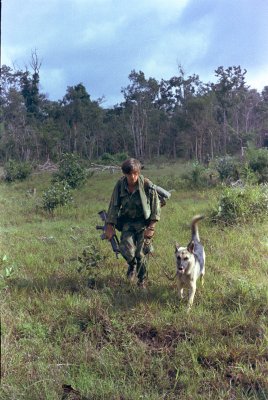 Thanks to Mike Lemish
The 1st Cavalry Division was a very special type of unit and the commanding general during our period, Major General John Tolson, described the combat troopers of his division as having a “can do” attitude and they “enjoyed exceptionally high morale”. Later in the text we will identify some of those things that contributed to this esprit de corps, but as we moved from An Khe to Landing Zone English, we recognized that we were in Cavalry Country. This was made clear to us by the presence of numerous 1st Cavalry Division patch emblems painted on prominent large rocks in many different locations, and it was our understanding that these represented trespassing warning signs and the target audience was our enemy – the North Vietnamese Army (NVA) and local Vietcong (VC) guerrilla units.
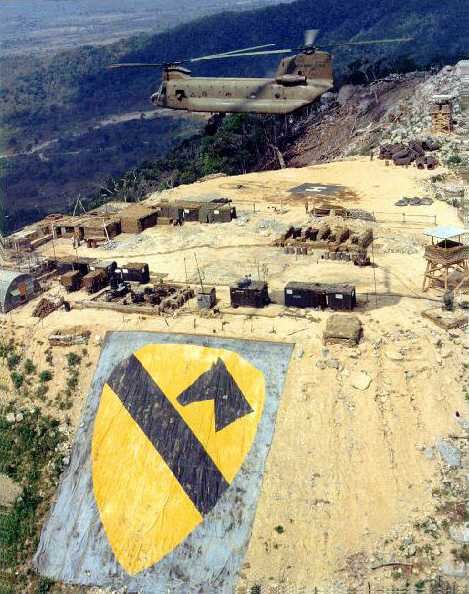 Thanks to 1st Cav Div Assn