
LANDING ZONE CAROL (FSB RIPCORD)
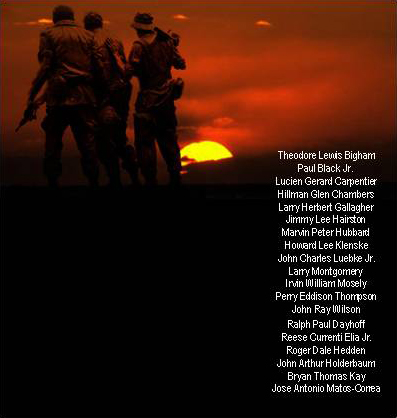
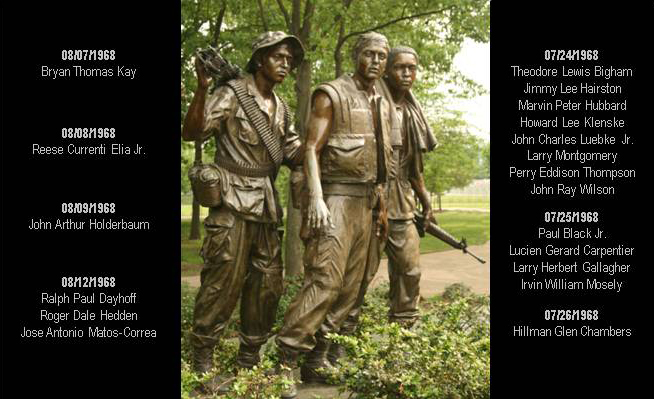
This account is dedicated to the memory of our fallen buddies and comrades who were killed in action (KIA) during these firefights:
These Bravo Company firefights were the beginning of a long and vicious contest between US and NVA forces for control of the chain of mountains surrounding LZ Carol. The 1st Cavalry Division established LZ Carol on Hill 927 (YD343194) in July 1968, but it was abandoned at some later date, probably around the time when the division moved south in October 1968. LZ Carol was reoccupied in March 1970, this time by the 101st Airborne Division and they gave it a new name - Fire Support Base (FSB) Ripcord.
LZ Carol/ FSB Ripcord achieved a notorious reputation as a hilltop that was fiercely contested by NVA forces on a level equal to the siege of the Marine base at Khe Sanh during January-April 1968. The reason for this was that the area surrounding LZ Carol was a huge NVA logistical complex and important staging area for enemy operations in Hue and Quang Tri, and the NVA had no intentions of ceding control of this vital territory to US Army units. As Bravo Company can attest from their firefights during July-August 1968, the NVA fought fiercely for this territory and they succeeded in compelling the 101st Abn Div to abandon FSB Ripcord after a 23 day siege with extremely high friendly losses in July 1970. During their occupation of FSB Ripcord from 12 March to 23 July 1970, the 101st Abn Div sustained a total of 248 KIAs.
Recent research shows that the 101st Abn Div losses during the siege of FSB Ripcord, 1-23 July 1970 (75 KIA and 345 WIA), exceeded the casualties sustained during the infamous battle of “Hamburger Hill” in 1969, located 22 kilometers south of LZ Carol/FSB Ripcord in the A Shau Valley. Apparently the 101st Abn Div soldiers who fought on FSB Ripcord during 1970 dubbed it “Cheeseburger Hill”. Cheeseburger Hill had the same meaning as Hamburger Hill, the nickname used by 101st Abn Div soldiers who fought there because they felt that they were “chewed up like a hamburger”.
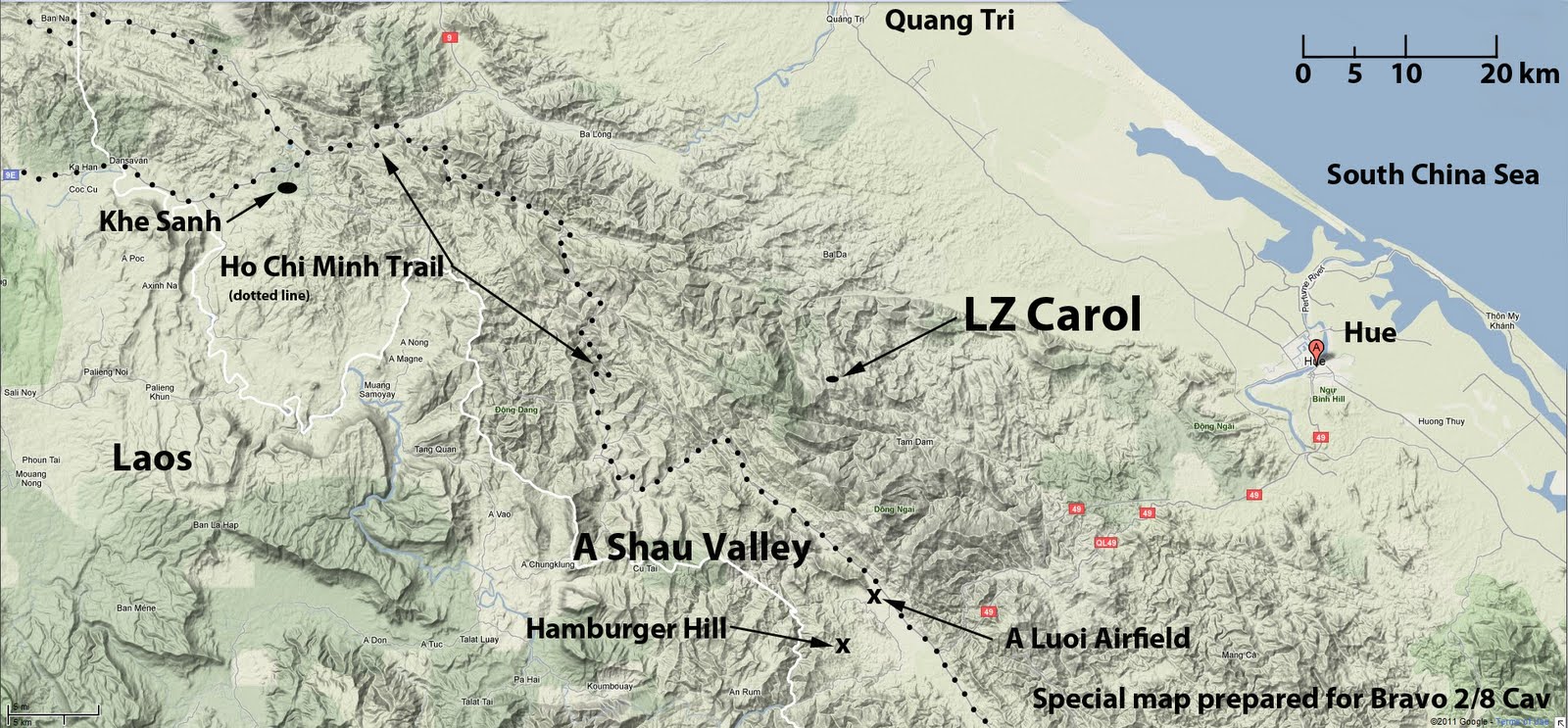
KHE SANH &
HUE OVERVIEW MAP
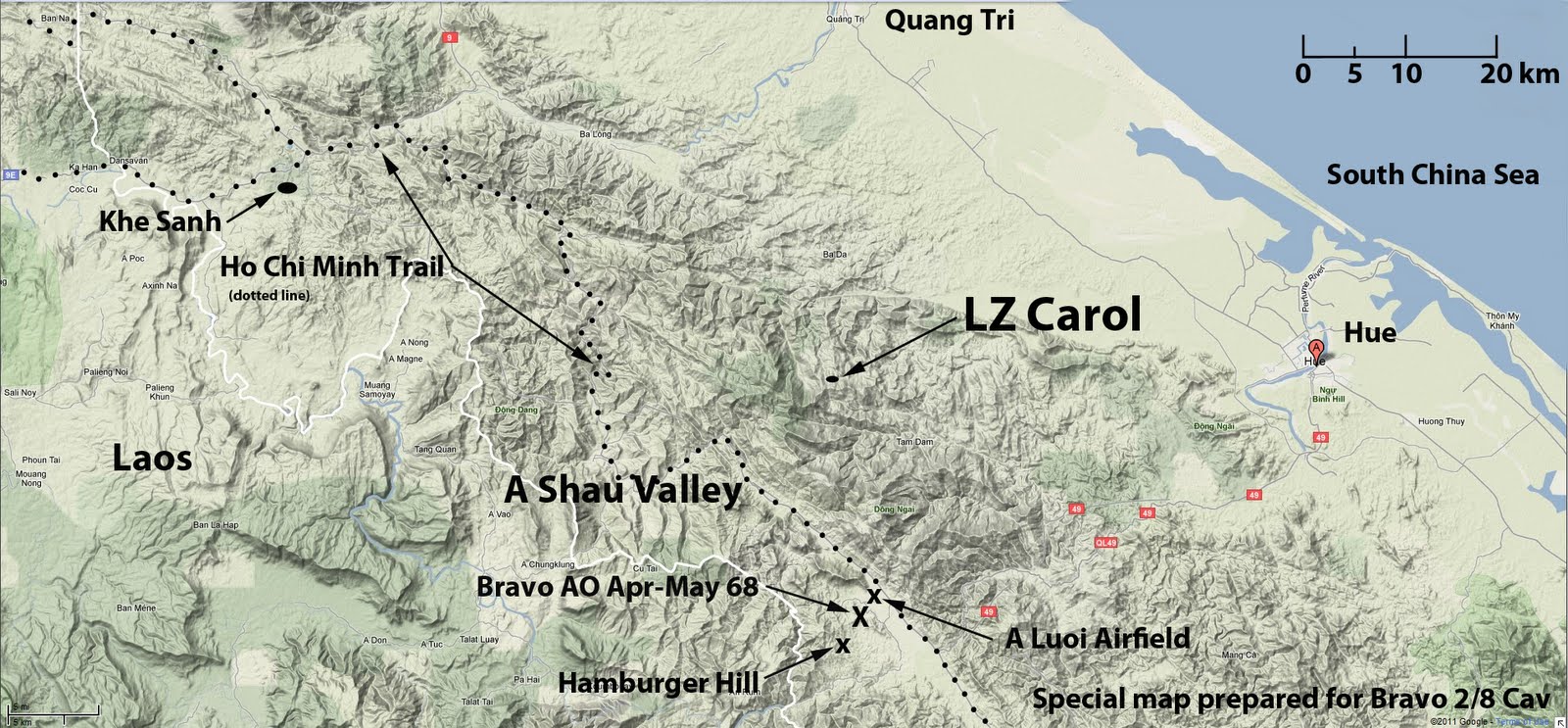 Click on Map, to see a more detailed version.
LZ Carol was located on the northeastern edge
of the A Shau Valley and Bravo Company was no stranger to this region
having participated in the 1st Cavalry Divisions air assault
into the A Shau Valley during April-May 1968. The A Shau Valley was a
crucial part of the Ho Chi Minh Trail and served as one of the main
points of entry for the infiltration of NVA troops and supplies into the
Northern Military Region from Laos. LZ
Carol was
18 kilometers east of Laos,
a country that the NVA exploited as a safe haven for moving troops and
supplies into South Vietnam. The chain of
mountains surrounding LZ Carol were used by the NVA as a logistical
supply base for supporting the NVA’s 29th and 803d Regts, 324
B Division, and the Co Pung mountain mass (YD336108) was appropriately
nicknamed “The Warehouse” by US forces. The NVA had a network of trails
from Laos
to their logistic storage areas vicinity of LZ Carol, and these trails
continued east to Hue and north to Quang
Tri. There were indications that animal drawn carts were used on some of
these trails for transporting supplies. The terrain around LZ Carol was
mountainous, very rugged and covered by dense forests in all directions.
The notable lack of suitable landing sites, coupled with effective enemy
ground fire against our helicopters, seriously hindered airmobile
operations in the LZ Carol area during July 1968.
Our battalion (2nd Bn, 8th
Cav Regt) was a 1st Brigade unit and our normal operating
area was to the west, north and east of Quang Tri. However, our
battalion was placed under the operational control of the 2nd
Brigade on/or about 21 July and assigned the mission of establishing a
firebase on Hill 927, named LZ Carol, and conducting search and destroy
operations in the surrounding mountains. The 2nd Bn, 8th
Cav Regt conducted offensive operations in the vicinity of LZ Carol
until they reverted to 1st Brigade control on 26 August 1968.
The 2nd Battalion, 5th Cavalry Regiment (3rd
Brigade) took control of LZ Carol on 26 August.
The following information on the 22-26 July operations is
based on the official 2nd Bn, 8th Cav Regt Staff
Journals and accounts from former troopers who served with Bravo Company
during this period. To set the scene, a few words about this particular
operation are needed. Although we spent a year fighting in various
regions of Vietnam, we could still
recognize and appreciate the beauty of much of the countryside. But when
you read the following accounts of combat operations in the mountainous
jungle surrounding LZ Carol, keep in mind this poignant description by
one of our troopers -
the entire area was just
evil!
GOOGLE
SATELLITE PHOTO OF LZ CAROL
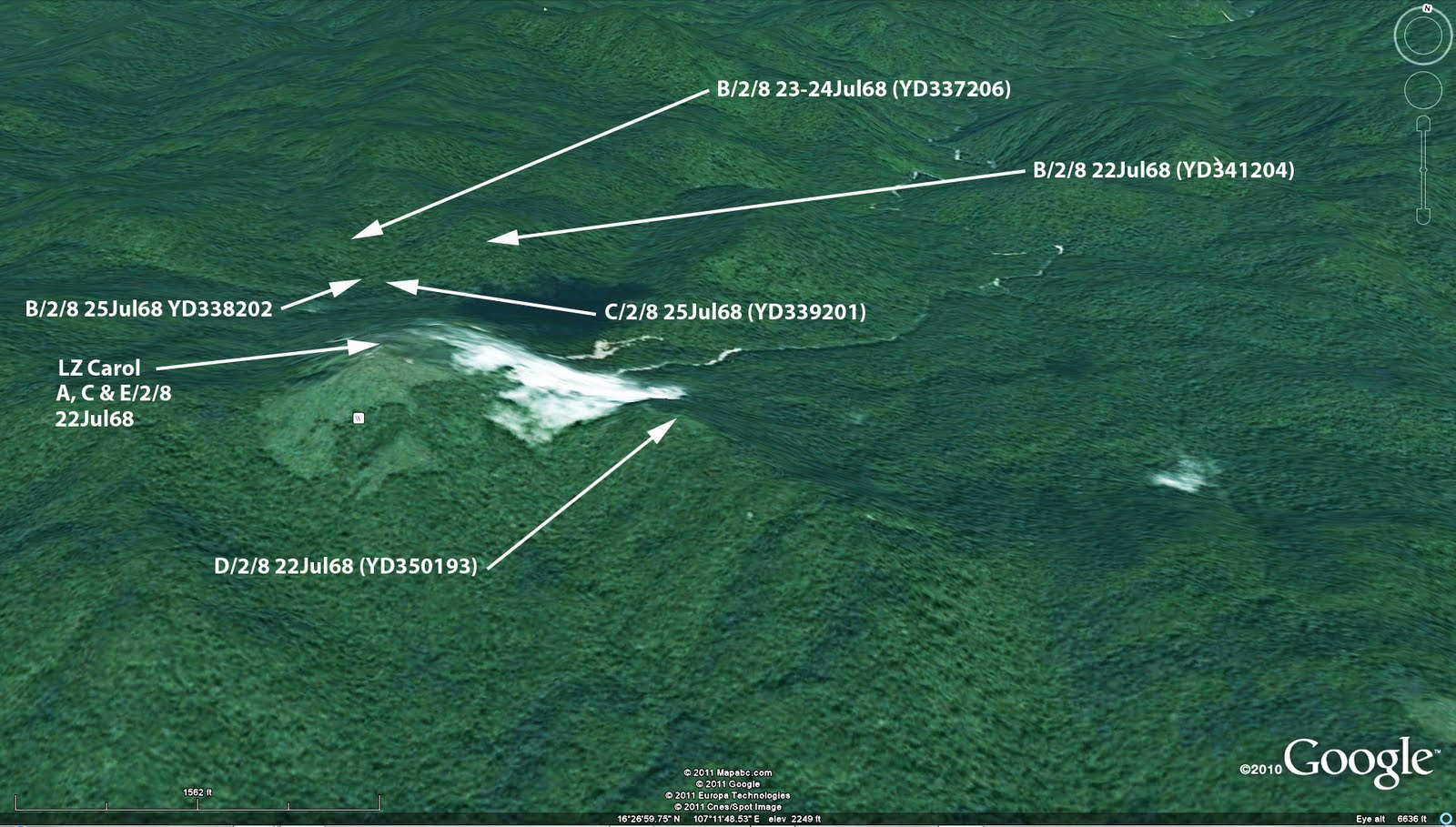 Click on Map, to see a more detailed version.
BRAVO COMPANY
ACTIONS 21-26 JULY 1968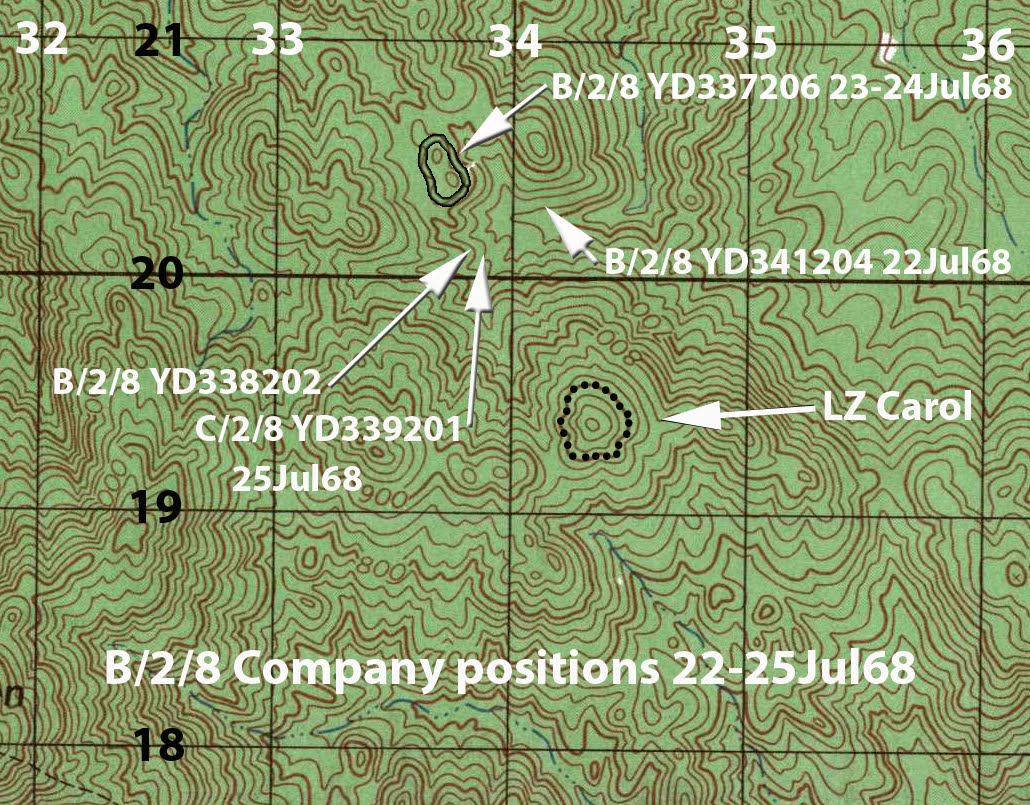
21 July:
Based on reports from Bravo Company troopers on
the initial assault helicopters, it is highly likely that the US Air
Force had used a “Daisy Cutter” bomb to clear the trees and jungle
growth on Hill 927. Whenever a Daisy Cutter was used to clear a landing
zone, the end result was always lots of tree stumps, jungle debris and
bomb craters. This bombing strike would be conducted shortly before the
combat assault and the final artillery barrages on the landing zone.
Bravo Company conducted an air assault on Hill
927 on or about 21 July with Blackfoot in the lead helicopters. There
are reports that it was necessary to repel the last few meters from the
Hueys and also the need to rapidly clear the landing zone area of debris
to facilitate the landing of artillery guns and other units. Bravo
troopers report sniper fire and probing attacks shortly after touchdown.
After securing the landing zone, an artillery battery, Charlie Company
and Echo Company were airlifted to LZ Carol. In addition, the 2nd
Bn, 8th Cav Regt established a battalion forward command post
on LZ Carol. Charlie Company was given the mission of securing LZ Carol
and there are unconfirmed reports that the company had several
casualties immediately after arriving on LZ Carol. Bravo Company
conducted search and destroy operations to the north of LZ Carol.
22 July:
Charlie Company continued to secure LZ Carol
and conduct local patrols around the firebase. Alpha and Delta companies
were released from the operational control of the 1st Bn, 5th
Cav Regt on 22 July, and both companies were airlifted to LZ Carol.
Delta Company conducted search and destroy operations to the south of LZ
Carol and their night location was at YD350193. Alpha Company was
airlifted to LZ Carol at 1807 hours and spent the night on the firebase.
One of the 229th lift ships transporting Alpha Company was
hit by enemy fire as it approached the LZ. There were no friendly losses
and the helicopter was extracted on 23 July.
Bravo Company continued to conduct search and
destroy operations to the north of LZ Carol with no enemy contact. Their
night location was at YD 341204, and foxhole strength was 4 officers,
105 enlisted and 7 attached (medics and artillery forward observer
team).
23 July:
Charlie Company continued to secure LZ Carol
and conducted local patrols around the firebase. Alpha Company conducted
search and destroy operations to the west of LZ Carol (YD 338192) with
no significant contacts. Delta Company conducted search and destroy
operations to the east of LZ Carol, engaged 2-3 NVA and captured
assorted military equipment at YD356191.
0935: Bravo Company engaged 2 NVA soldiers moving on a NW TO SW trail, vicinity of YD339206. Bravo’s log supply ship reported receiving small arms fire from the same general area.
1745: Bravo Company received small arms fire with no casualties. Bravo Company night location was at YD337206, and foxhole strength was 4 officers, 105 enlisted and 7 attached.
24 July:
0810: Bravo Company engaged 3-4 NVA soldiers
vic YD337205, resulting in 1 US WIA.
0820: A large enemy force attacked Bravo’s
perimeter and overran one of Blackfoot’s machine gun positions. The
perimeter was reestablished and friendly artillery fires were called in
on enemy positions. There was a short break in the fighting and then the
enemy resumed the attack with automatic weapons and grenades. Friendly
losses were 8 KIAs and 3 WIAs. In addition, a Vietnamese interpreter was
KIA.
Three attempts were made to evacuate Bravo’s
casualties, but all of these medevac choppers received hits from enemy
automatic weapons and the aircraft commander was forced to cancel these
missions because of mechanical problems. These medevac operations are
described in detail at
http://www.eagerarms.com/medevac.html
. On the first medevac attempt at 0950, the door gunner was shot in the
head, the co-pilot was slightly wounded from shrapnel, and the chopper
engine took some hits but made it back to Camp Evans. On the second
medevac operation at 1225, a Bravo trooper was hoisted up using a jungle
penetrator, but he was shot in the hand during the hoisting operation.
The Crew Chief was wounded by shrapnel and the chopper hydraulic system
was hit forcing another emergency return to Camp Evans.
1505: Medevac made a third attempt to pick-up Bravo’s wounded troopers. While hovering over Bravo’s position, the aircraft commander was shot and the chopper took so many hits that it was forced to make a crash landing because of engine failure. All crew members were rescued within 30 minutes of the crash.
1645: Bravo received small arms fire from the south with no casualties. No aerial medevac operations were possible to evacuate Bravo’s KIAs and WIAs. It is believed that a B-52 or some type of air strike was conducted in the general area during the night. Bravo night location was at YD337206, and foxhole strength was 3 officers, 97 enlisted and 5 attached.
IN
MEMORY OF
25 July:
Alpha Company took over security of LZ Carol
and conducted local patrols. Charlie Company conducted search and
destroy operations north of LZ Carol and rendezvoused with Bravo at YD
339201. Delta Company conducted search and destroy operations with
negative contacts (YD 357191).
1300: Bravo received sniper fire, vic. YD 338202, resulting in 1 US KIA.
1520: Bravo received automatic weapons fire, vic YD 338201, with negative casualties.
1630: Bravo received automatic weapons fire, vic YD 337202, resulting in 4 US KIAs and 1 US WIA. No aerial medevac operations were possible to evacuate Bravo’s KIAs and WIAs.
Charlie Company rendezvoused with Bravo in the
late afternoon for the purpose of assisting evacuating Bravo’s KIAs to
LZ Carol. During the difficult link-up with enemy forces all over the
area, both units used their radio call signs for identification
purposes, “Eager Arms” for Bravo and “Lone Armor” for Charlie.
There was one Bravo KIA during the link-up. According to the
recollections of one of Bravo’s troopers, “we were especially vulnerable
since it takes at least 2 or 3 troopers to carry each of our fallen
comrades and most of the wounded required some assistance”. Charlie
Company night location was at YD339201. Bravo Company night location was
at YD338202, and foxhole strength was 3 officers, 92 enlisted and 5
attached.
26 July:
Alpha Company continued to secure LZ Carol and
conducted local patrols. Delta Company conducted search and destroy
operations vic. YD361192. Charlie Company assisted Bravo with evacuating
casualties to LZ Carol.
0750: Bravo received automatic weapons fire from SE resulting in 1 US KIA.
1615: Medevac requested on 24 July was completed. All of Bravo’s WIAs from 24-25 July were evacuated. Based on information from a medic who was one of the WIAs, these helicopter evacuations took place at the base of Hill 927 and they were lift missions requiring the use of a rigid litter and jungle penetrator.
1830: Bravo and Charlie Companies arrived at LZ Carol with all of Bravo’s KIAs (13 US and 1 Arvn interpreter).
Bravo Company night location was at LZ Carol,
and foxhole strength was 3 officers, 80 enlisted and 6 attached.
According to the recollections of a Bravo
Company trooper, there was a critical shortage of food as the last
resupply was on 23 July: “I
specifically remember mixing a concoction of coffee, cocoa,
powdered cream and sugar because that was all we could scrape together
from 4 or 5 guys, but we had water from the sky”. On their arrival at LZ
Carol on 26 July, these troopers were starving and they received packs
of Long Range Recon Patrol (LRRP) rations. These were freeze-dried
rations and according to one trooper, these LRRP rations tasted “like 4
star cuisine from a New York City restaurant after what we went
through”.
CONCLUSIONS
The above extracts from the official 2nd
Bn, 8th Cav Regt Staff Journals provide specific details on
the key events during 22-26 July, but we are left with many unanswered
questions about the actions of Bravo Company. Nevertheless, there are
sufficient facts available to make some reasonable conclusions
concerning the restrictions imposed by the rugged jungle terrain and,
most importantly, the inability to medevac the large number of
casualties - 13 US KIA, 1 ARVN interpreter KIA and an unknown number of
wounded.
Under normal circumstances our awesome
airmobile assets provided us with the means to rapidly conduct surprise
attacks, reinforce units in contact, block enemy escape routes, extract
units in contact, resupply units with ammunition and food, and to
quickly evacuate all our casualties by specially equipped Huey
helicopters. It is important to emphasize that we could not exploit
these airmobile capabilities in the LZ Carol area of operation because
of the rugged jungle terrain, and the effectiveness of enemy automatic
weapon fire that resulted in the loss or damage to 3 medevac
helicopters, one lift helicopter on LZ Carol and the Bravo supply
helicopter received several hits. The double-canopy trees and steep
mountain slopes meant that there was a critical lack of suitable
helicopter landing sites and the dense jungle canopy also restricted the
effectiveness of our supporting fires – artillery, gunships and tactical
air. These significant restrictions not only reduced our combat
advantage over enemy forces, but they also meant that we were unable to
medevac our casualties and this seriously hindered Bravo’s ability to
conduct offensive operations.
In a nutshell, Bravo Company became hostage to
our casualties in terms of our inability to attack or move to another
location. This trapped situation was the direct result of the casualty
evacuation requirements, whereby at least 3 troopers were needed to
carry each KIA and his equipment. This meant that a minimum of 42
bearers, nearly 50 percent of the company strength, were required to
evacuate the 14 KIAs and some of our seriously wounded troopers also
required assistance. The enemy situation was another important factor
because the surrounding jungle at Bravos’ location was infested with
highly-trained NVA soldiers who were not only thoroughly familiar with
the mountainous jungle trail network, but they were also experts at
exploiting this knowledge for selecting well-positioned ambush sites for
engaging us and our helicopters. Consequently, attempts to move were
severely hampered by the requirement to carry the large number of
casualties, the steepness of the mountainous terrain, the density of the
jungle canopy, and the constant NVA ambushes and attacks added to
Bravos’ casualty count.
Those who observed Bravo Company troopers
entering the perimeter at LZ Carol late in the afternoon of 26 July
vividly remember the haunted look on their faces. Words can never
describe the experiences endured by these courageous troopers, among
others; the utter wretchedness and horrors of close combat for several
consecutive days, seeing their buddies and leaders killed by enemy
automatic rifle fire, being under constant enemy pressure from all sides
for eighty-one hours, having to carry their dead buddies and leaders
through mountainous jungle terrain to LZ Carol, and suffering greatly
from fatigue and hunger.
In addition to honoring our troopers who were
killed in action during the LZ Carol operation, we also wish to pay a
special tribute to all those brave and courageous Bravo Company troopers
who participated in combat operations in this “hellish” area in the
vicinity of LZ Carol during the period 21 July to 26 August 1968. Based
on the evidence documented here, one can now say that being a veteran of
the operations at LZ Carol/FSB Ripcord is a mark of great distinction
among combat infantry veterans, particularly those of the 1st
Cavalry Division (Airmobile) and the 101st Airborne Division.
Evidence of the very special bonds that are
forged among combat soldiers in wartime, together with the esprit de
corps of 1st Cavalry Division infantry companies, is clearly
evident in these comments made in 2011 by a former Bravo Company trooper
who participated in the 23-26 July 1968 firefights:
”There were heroes during those
few days for sure, but it is more about the guys who didn't come back or
were wounded, and the rest of the company pulling together to get the
hell out of there and living to fight another day.”
Be sure to read this gripping first-hand account on the above operation by Reese Elia, who was killed in action a few days later on 8/8/68.
First a little background information. We received this newspaper article from a Bravo trooper, Jim Rowell, on 10/9/2012. Jim, many thanks for saving and sharing this with us.
This article was prepared sometime between 7/27 and 8/7/ 68, by Donald Lonsway, a draftee military staff journalist assigned to 2nd Bde, 1st Cav Div. Unfortunately, Don died on 10/23/2011, but we did learn that he had spent a year teaching before serving in Vietnam. We can assume that Don interviewed Reese at LZ Carol a few days after the 22-26 Jul 68 operation. As Reese was also a teacher before joining the Army, it is highly likely that this shared teaching experience pulled these two together and we ended up with this gem of an article. There is one error - there were three medevac missions, not two. The name of the newspaper that published this article is unknown (Cavalier Magazine?), and the generic photo of the three troopers could not be reproduced.
Cav Grunt Tells It Like It Is
By PFC Reese Elia
as told to
SP4 Don Lonsway
Cavalier Staff Writer
It was around 8 a.m. when we moved out under a heavy overcast sky. The terrain was steep with very few trails. Overhead, a triple jungle canopy blocked out most of the light from above. Progress was slow because of the thick growth. During the first day we didn't contact the enemy, nor did we see any real evidence of him except for an occasional trail. The only real signs of life we saw that day were "tiger tracks" and "elephant dung'. We never saw either one of these animals and didn't really want to.
That night, we set up on a small hill. The night passed without incident. The next day we moved out early with our platoon and my squad walking point. The going was slow. After a short while we stopped to take a rest. That's when the point man spotted two NVA. He fired on them and they took off. He thought he hit them so we started to follow.
We moved up a small trail and came to a group of large boulders piled on top of one another to form what appeared to be several caves. A sandal and some bare footprints let up towards the rocks. We also found several vines that had been stretched from tree to tree, perhaps as a clothes line. There were many large leaves lying on the ground. Maybe they had fallen naturally, but they could have been carefully spread by someone to dry. The NVA use these leaves with bamboo to make their huts.
We started to move up the hill and spotted one enemy in a well fortified position. He opened up on us and we ducked for cover behind the boulders. We fired on him, but no assessment was made.
By then it was raining heavily and the wind was cold. The rain makes it seem spooky in the jungle. The growth is so thick the rain doesn't fall to the ground all at once. It catches on the canopy and trickles slowly off the leaves. It sounds like a man walking.
We broke for chow and decided to move to another hill for the night. Shortly after we moved out, several of us thought we heard voices. We stopped and listened, but finally decided it must have been the rain. Later that afternoon the point man spotted another NVA and fired on him, but he got away.
We set up for the night and ate our last meal. We had taken six "C" Ration meals each, planning on resupply the next morning. It rained hard all that night. The wind blew, making it very cold.
the next morning it was still raining hard. We were just getting ready to pull out when five or six Charlies hit us on the other side of the perimeter. We killed three, but took casualties ourselves. Medevac was called and we managed to get one guy out with a jungle penetrator. The second ship that came in was shot down.
We decided to find a different landing zone (LZ) so we could bring in another medevac bird. A location was selected. We blew a big tree and started clearing away some of the brush. Someone spotted an enemy patrol coming down a trail. We opened up on them, hitting two. It was decided then that they couldn't chance bringing in another "bird". We were going to have to hump (carry) our wounded.
We set up for the night on another hill. With no resupply, everyone was hungry. The wind and rain made it a very cold, uncomfortable night.
The next morning we made stretchers for the casualties out of ponchos. At that time, we had three WIA's with a three kilometer hump back to the LZ. We finally moved out with four men each on the WIA's stretchers. It was slow moving. The terrain was steep and thick and the guys were frequently stumbling on the roots and rocks. We had moved only a short distance when we heard the crack of an AK-47. The burst left the rear security man for second platoon dead. That gave us another body to carry and made us more uneasy than ever. We were expecting to be hit any minute, especially when we crossed each of the many stream beds. The men were exhausted, but we still pushed on.
We learned that two platoons from "C" Company had left the LZ and were headed out to link up with us. That was very encouraging.
We moved down a hill, crossed a stream bed and started up the other side when we were hit hard by automatic weapons. We tried to pull back but we were hit harder from the other direction. 'Charlie' had us pinned down. I don't know how long; by then we had lost all track of time. Our wounded --the enemy--the jungle--getting back alive; these are what held our thoughts. Then, as quickly as he came, Charlie disappeared back into the jungle.
A short time later, the two platoons from "C" Company linked up with us. You'd think an entire brigade had joined us by the reaction of the guys. I remember this one guy who walked into our perimeter tossing out packages of cigarettes--it was just like Santa Claus at Christmas.
For food, all they had were a few cans of C-rations which they willingly shared with us. With renewed hope and a heightened morale, we set up on a nearby hill for the night. During the night two of our wounded died. .
Morning came and with it our fifth and final day. It was our third day with little food and water. This was, I think, our worst day. We were all very tired. We all feared being hit by Charlie again at any time. We had the casualties to hump and all their gear. When we first started, I hoped I wouldn't have to get near any of the bodies. I didn't want to see my buddies dead. Before the ordeal was over, I was humping without a second thought. It was rough. We had used most of the ponchos because they'd rip after a short while from strain or getting caught on a rock or root. Some of the guys had to carry the bodies uncovered slung over their shoulder. Anything, so we wouldn't have to leave him out there.
I really felt sorry for the wounded. The growth was thick and difficulty to move through. Occasionally, a man carrying a stretcher would stumble and fall dropping the litter and bringing a cry of pain. The litter was heavy. You could carry it for awhile and then yell for perhaps 15 minutes to get someone to relieve you and then it seemed like only a few minutes later and it was your turn again.
Early that morning we were hit by a sniper again but no one was injured. We pushed on with fear of ambush more prevalent than before. We were told that if we could keep up the pace we'd make it back to the LZ before dark. We prayed--pushed on--prayed, harder than any of us ever prayed before.
Then we heard the words--we'd reached the perimeter of the LZ. We'd finally made it. As guys climbed the hill and reached the sanctuary of the tiny LZ, tension was released and emotions took over. With tears rolling down their cheeks buddies would embrace one another as if greeting a long lost friend. "Thank God! Thank God! Thank God! We made it. . . we're still alive!" These were common words heard expressed all over.
One of the most ironical things about the whole five days was that the majority of us never even saw the enemy. We heard their fire, were pinned down by them, saw our buddies next to us cut down by one of their bullets, but still, most of us never saw him.
I guess all I can say -- like any of us -- is thank God, we made it!
Acknowledgements:
Many thanks for providing valuable input for
this article on LZ Carol to: Steve Bird, Ben Evans, Pete Genecki, Gene
Hedberg, Art Jacobs, Jim Miles and Mark Thielen.
Many thanks to Jim Beck for the fantastic maps and memorial photographs.